Creating a capabilities map for partner training and customer education.
In order for learning to go from a cost center to a growth lever, it must connect directly to desired business outcomes.
Translating desired business outcomes—better renewal rates, more partner-source revenue, faster time-to-value—into a learning program requires triangulating the needs of the business, the market, and individual learners in order to derive a library of capabilities that are impactful for all three. The goal should be to create a content strategy that is actually a capabilities one, reverse-engineered from the desired business outcome and powered by the individual learner’s own motivation.
Throughout the years, we’ve seen many names for this approach: skills mapping, competency mapping, skills-based learning, and more. Where capability mapping for customer education and partner training differs from the standard approach is centering measurable business outcomes, rather than general learning objectives.
In this post, we’ll walk through our method of creating a capabilities map for customer education or partner training—any scenario in which learners’ participation is simultaneously entirely voluntary and business critical. We’ll walk you through transforming a high-level business objective into a learning content strategy.
What is a capabilities map?
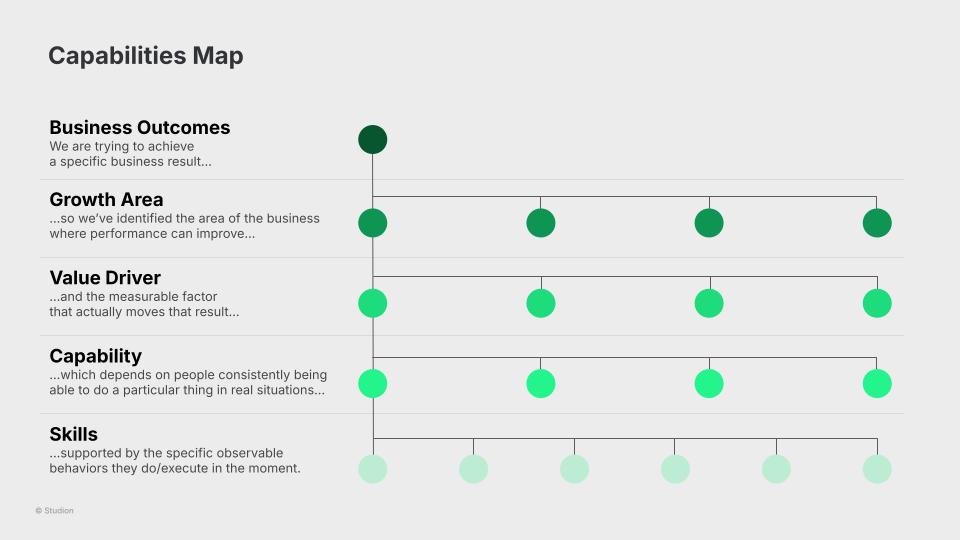
A competency map or capabilities map is an information architecture diagram that shows the relationship between individual skills, the capabilities they enable, and the business outcomes they drive.
For business leaders, it draws a straight line between learning and business outcomes. It also enables matching learning resources to business priorities. It is especially critical for enterprise customer education or partner training, which often involves large, cross-functional teams.
For learning practitioners, it provides a clear roadmap for content prioritization. The mapping process validates learning content development, so each item within the learning experience serves a distinct purpose. Every content piece is tied directly to a specific capability, which then maps back to the business outcome leadership cares about. The capabilities map protects against the creation of superfluous or meandering content and ensures learners receive distilled, impactful learning throughout the course.
For learners, it ensures that they are building the skills with the most real-world value. It avoids the dreaded “check the box” training. When learners derive true value from your learning experience, that’s when training becomes a growth lever that builds brand equity.
In practice, the capabilities map provides answers to the key questions involved in launching a new learning initiative:
- How do we transform our sprawling content library into an effective learning experience?
- What content do we keep, what do we discard, and where are the gaps we need to fill?
- Which learners are we trying to reach, and how are they similar or different?
- How do we ensure we’re building a relevant, engaging experience that imparts real skills to each group of learners?
- How do we build a clear case for this initiative to leadership?
Drawing a capabilities map
The capabilities map is a foundational step in the design of a new learning experience or revitalizing an existing training program. We see four essential get-rights for any customer education or partner training program: strategy, content, technology, and operations. A capabilities map connects content to strategy. In articulating the desired business outcomes and deriving the skills needed to obtain them, you can elucidate the complexity of the learning program. Most importantly, you can use the map to prioritize which skills to focus on, and thereby which learning content to create first. Here’s a step-by-step guide to drawing your learning content roadmap.
Start with business outcomes
Identifying the business goal you wish to influence is the obvious first step. Some example business outcomes we’ve helped clients pursue include increasing partner-sourced revenue, supporting a successful new product launch, improving customer retention, and expediting product adoption.
Define growth areas
With the overarching goal solidified, you can turn to assessing growth areas. Which levers can you pull in service of the business objective? If the intent is to drive revenue growth, for example, you may optimize for a shorter sales cycle, increased client acquisition, the expansion of existing client relationships, or additional sales of a new high-value product or service.
Breaking high-level business objectives up into their component parts creates the granularity needed to progress to individual, teachable skills.
Drill down to the value drivers
At this stage, you “put a number” on value drivers. Calculating the impact of learning programs is notoriously difficult. It’s important to identify the key performance indicators you plan to influence during the design phase of a learning program, not as an afterthought! Setting a KPI goal linked to a value driver is often a more feasible undertaking. For example, a customer education KPI might be the usage of a specific product feature within a given timeframe. A channel sales KPI might be active referral sources or share of wallet.
Deriving capabilities for real-world impact
For our purposes, capabilities are defined broadly as professional skillsets. These skillsets must be both demonstrable and flexible. Capabilities are outcome-oriented rather than process-oriented; a learner needs to be able to selectively pull from their skills arsenal to demonstrate the capability.
Importantly, they do not have to be directly tied to your organization–they are not merely the ability to adopt or sell a product feature. For example, a data analytics SaaS company’s customers will need to have analytical capabilities in order to effectively use the product. For a channel sales example, a capability might be new client acquisition. Analytical capabilities and fostering positive client relationships are not inherently tied to any one brand, but they might nevertheless be required for your brand’s success.
Skills mapping as the final step
Finally, we arrive at skills mapping. At this stage, we address the question: What specific, observable behavior does each learner need to execute to enact the capabilities we’ve identified for them? We then parse a capability like data analysis into its smaller parts, such as selecting the appropriate data visualization or identifying key variables. For the client relationship capability example, it might be proactively sharing valuable advice and finding natural opportunities to deepen the client relationship.
The exercise of skills mapping is the final step in drawing a clear line between the overarching business goal and the individual skills each learner must cultivate in service of it.
Segment capabilities by learner personas
In order to create effective, personalized learning experiences, rather than one-size-fits-all training programs, it’s essential to further segment a capabilities map by learner persona. Each organization will have its own personas, so this will look different for everyone. But one common example is segmenting based on seniority. Someone earlier in their career will need to build different capabilities than someone further along. To keep learning experiences relevant, stratify a capabilities map by learner persona. Importantly, this includes selecting different value drivers for different learner personas and segments.
Returning to our channel sales example where the growth area is client acquisition and retention:
- Junior sales people need basic client acquisition skills
- Mid-career professionals need to improve their ability to add strategic clients
- Later career partners need to focus on client retention and transitioning active client management to more junior partners.
In this example, while everyone has an area for growth, and all of those areas are related to the same business objective, the actual skills differ.
A step beyond skills: considering learner attitudes
As you build out your learning content, it’s not enough to focus solely on imparting skills. Learners also need to believe those skills are worth their time, and that they can put them to use in the real-world.
Elucidating the real-world value of a learning experience—drawing a clear connection to what learners can expect to achieve and how they can apply their new capabilities—is key to creating highly engaging learning experiences. Create opportunities for realistic practice, and build assessments that reflect the scenarios they’ll see in the real world. Your learners will also value actionable feedback.
The capabilities map in action: two case studies
To see how the capabilities map works in practice, we have two different client examples.
AICPA + CIMA’s competency-based learning
The first case study is from a professional development program for finance professionals. The learning experience is designed around building competencies, or capabilities. Read the full case study here.
Partner training to support a product launch in financial services
A large financial services firm relied on a network of independent, non-captive financial advisors to sell their products. They launched a new product line, and they needed their partner sales force to both understand and promote the new product. Read the full case study here.
Mapping a path to effective learning experiences that drive growth
Designing an effective learning experience for an organization with diverse learner segments, stakeholders who need to see the value before signing off, and/or complex, indirect go-to-market motions is complicated. Studion’s capabilities map is a framework that simplifies the process and draws a distinct line that runs from business goal to learner to capability and skills to content.
Decisions become easier when the “why” behind them is clearly articulated in the capabilities map.