
For many enterprise organizations, partner training has been treated as a cost center: a compliance checkbox, a line item to minimize, or an afterthought in the sales enablement budget. But that framing leaves enormous growth potential on the table.
In a recent webinar, “Designing Education as an Engine for Growth,” hosted by our partner Intellum, Furqan Nazeeri, CEO of Studion, made the case that learning, when designed, executed, and measured correctly, offers a powerful competitive advantage, especially for companies that rely on large, non-captive distributed partner networks.
Here’s a summary of the key takeaways from the webinar, a playbook to stop treating education as overhead and start designing learning as an engine for growth.
Balancing Mastery and Edutainment: The 10-Hour Philosophy
For years, the Learning field has been pulled in two opposing directions. On one side is the pursuit of mastery. In Outliers, Malcolm Gladwell famously defined this as a 10,000 hour undertaking [link]. On the other hand is the edutainment movement that’s limited by the modern attention span, often defined as a mere 3:00 minutes. This approach centers around the idea that if we just make learning short and fun enough (snackable content, gamification, bite-sized learning), then we can achieve learning objectives.
“It all sounds modern and engaging, but…learning is hard. And this is the dilemma. You can’t trick someone into doing something that’s hard,” says Nazeeri.
How then can we balance these two extremes? The solution for corporate learning is to strike the right balance of aiming for capability, rather than mastery or entertainment.
Research on the learning curve shows that the first hours of instruction produce disproportionately large improvements.
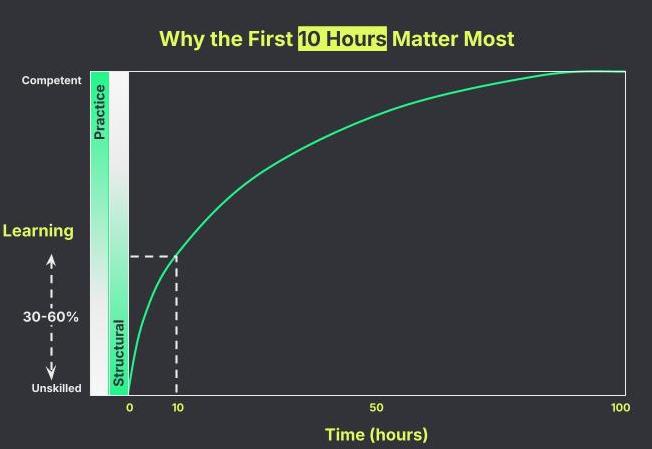
In this initial phase, learners are not just refining a skill; they are discovering a strategy and building a mental model that eliminates massive inefficiencies. Reaching this 10-hour inflection point moves a learner from “novice” to “capable,” unlocking the independence required for structured execution on the job. Extended enterprise training initiatives should aim to build capability, defined by 10 hours of learning, in order to unlock the greatest business value.
Capabilities Mapping: Start with Business Outcomes and Work backwards
Most organizations can easily pinpoint the business outcome they want. Very few can clearly describe the capabilities that will enable them to achieve those outcomes. This gap is where many programs go wrong before a single piece of content is ever created.
The most straightforward way to address this gap is to start with desired business outcomes, then reverse engineer capabilities:
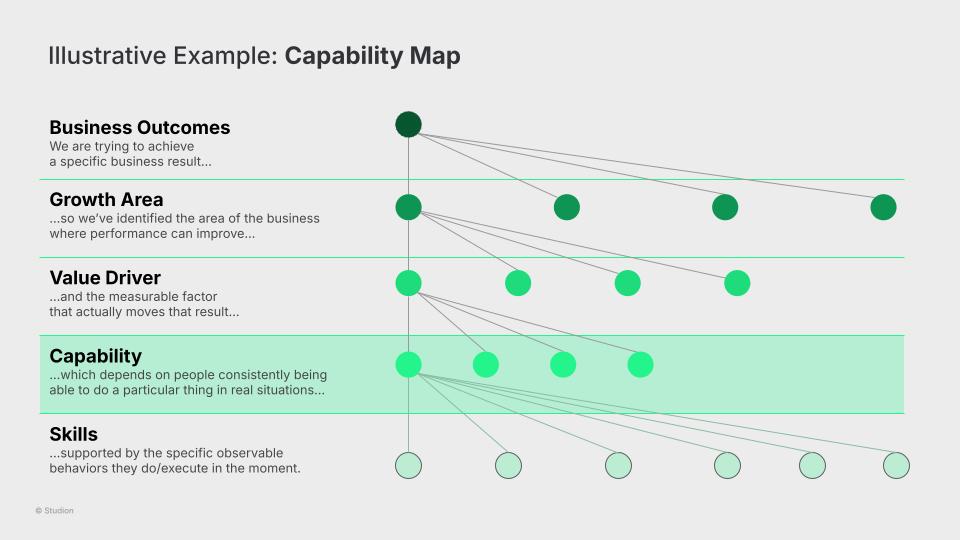
This capabilities map begins with business outcomes, then travels through growth areas and value drivers before arriving at specific capabilities, learnable, job-relevant behaviors that can be taught and practiced within a 10-hour experience.
High Engagement at Scale®: Designing the “How”
Once you’ve mapped learning capabilities to business objectives, the question becomes how to transform this roadmap into a learning experience that will engage learners while delivering business impact. Our approach, based on launching hundreds of online learning experiences over more than a decade, is called High Engagement at Scale.
High Engagement at Scale enables us to create an evidence-based learning strategy. It’s also a tool for feature prioritization. In every learning experience, there are a handful of make-it-or-break-it moments. We call these Signature Moments.
“Learners don’t always remember every piece of content. But they remember how they felt during the learning experience,” says Nazeeri.
It’s critical to carefully design and control the high-stakes moments in a learning experience.
Measuring Engagement as a Hierarchy, Not a Metric
One common mistake in measuring learning is treating engagement as a single number: time spent, completion rates, quiz scores. These metrics are easy to pull from an LMS, and they do matter, but they do not give a complete view of the learners journey. That’s why we prefer to think of measuring learning impact as a hierarchy, rather than any single KPI:
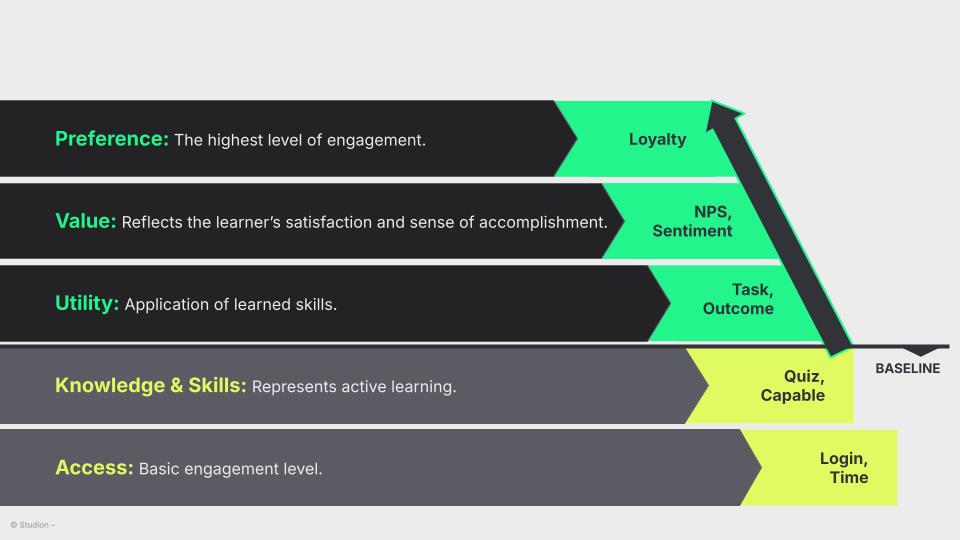
The Hierarchy of Engagement scoreboard spans a range of KPIs for different stages of the learner journey, from Access to Preference. Each level requires different data sources. Access metrics come from the LMS, Utility metrics come from CRM and PRM systems, Value metrics are captured by NPS, and Preference is measured through long-term retention and share of wallet.
The breakthrough happens when these layers can be stitched together: when you can draw a direct line from 10 hours of training to a measurable improvement in business outcomes. That’s what gets investment from executives who may have historically seen training as a cost center.
From Deck to Doing: Operating Model
Technology and strategy are not typically the limiting factors for large organizations trying to build effective channel training programs. The harder challenge is organizational alignment. Who is the owner? L&D? Sales enablement? Marketing? Customer success? In practice, the answer is often all of them…and thereby none of them.
When ownership is diffuse and no single team is accountable, even excellent strategy can stall. Getting the operating model right, like clarity on roles, decision rights, and who can actually move things forward, is frequently the differentiator between a successful initiative and shelf-ware.
And it must be a continuous process. Learning is not a one-time intervention. It’s consistent, calibrated intervention applied over quarters and years—with data flowing back into the design at every stage.