
How a global software company planned one trusted knowledge layer so every AI assistant, search experience, and learning journey draws on the same content.
Overview
A global SaaS company’s product knowledge was spread across its LMS, product documentation, and community, each with its own search and none of it ready for AI. The client’s goal was to unify their dispersed product knowledge to pave the way for AI applications and agents.
Studion assessed various technology options and ultimately designed a vendor-neutral target architecture: a Knowledge Base Service that indexes all content for hybrid semantic search and retrieval-augmented generation (RAG), and a User Profile Service that personalizes every answer. The result is one trusted intelligence layer for search, AI assistants, and the company’s in-product agent.
Organization
A global data integration, analytics, and AI software company with a large worldwide base of customers and partners. Stakeholders from learning, product documentation, community, partner enablement, and product teams came together to move from fragmented systems to connected ones.
Challenge
Over many years, the company built up a large body of expert knowledge: training courses and certifications in its LMS; guides, API references, and release notes in product documentation; and real-world examples in its community. Each source was valuable, but each lived in its own system with its own search. Customers, partners, and employees had to know where to look, and the same question could get different answers depending on which data source they selected.
The company also wanted AI agents, including an in-product assistant and a planned AI coach, to answer questions and guide people in their work. Those agents needed trusted, current content they could reach programmatically, and the existing systems weren’t built for that. LMS vendors had built RAG into their own chatbots but kept those APIs closed. The few LMSs offering MCP servers could only reach their own content, not documentation or community. Learner profile data stayed locked inside the LMS, and publishing still relied on manual SCORM uploads.
The mandate was to move from fragmented systems to connected ones: one knowledge layer that unifies learning, documentation, and community content, keeps it current and trusted, and makes it available to every human and AI experience the company builds next.
Solution
The result is a single AI-ready knowledge layer that every search experience, assistant, and agent can draw from.
Instead of adding a chatbot to each system, Studion designed a shared intelligence layer above them. It pulls learning, documentation, and community content into one indexed knowledge base, pairs it with a unified view of each user, and exposes both through standard APIs that any current or future experience can use.
Studion started by defining the company’s Signature Features: the experiences that tied user needs to business goals, from a smart front door and AI coach to a skill profile and partner on-ramp. We then evaluated three technology paths against three criteria: how well each enables those features, how flexible it is for the future, and how much effort it takes to deliver.
Three potential technology pathways:
- LMS + AI authoring: low effort, but custom features become workarounds and the AI roadmap depends on the vendor
- Headless LMS + custom front end + agents (recommended): keeps the LMS’s learner records and pathways, gives full control of the experience, and can be extended systematically
- CMS + custom LRS SaaS + custom content delivery layer: most flexible, but requires more customization to close the gap with custom features, records and pathing from scratch
A key finding: custom integration work is needed no matter which LMS is chosen. Agentic capabilities in the LMS market are still immature and closed, so Studion designed two vendor-neutral services to fill the gap: a Knowledge Base Service for hybrid search and RAG, exposed through MCP, RAG, and HTTP search endpoints, and a User Profile Service that unifies learning, product-usage, and engagement data for personalization.
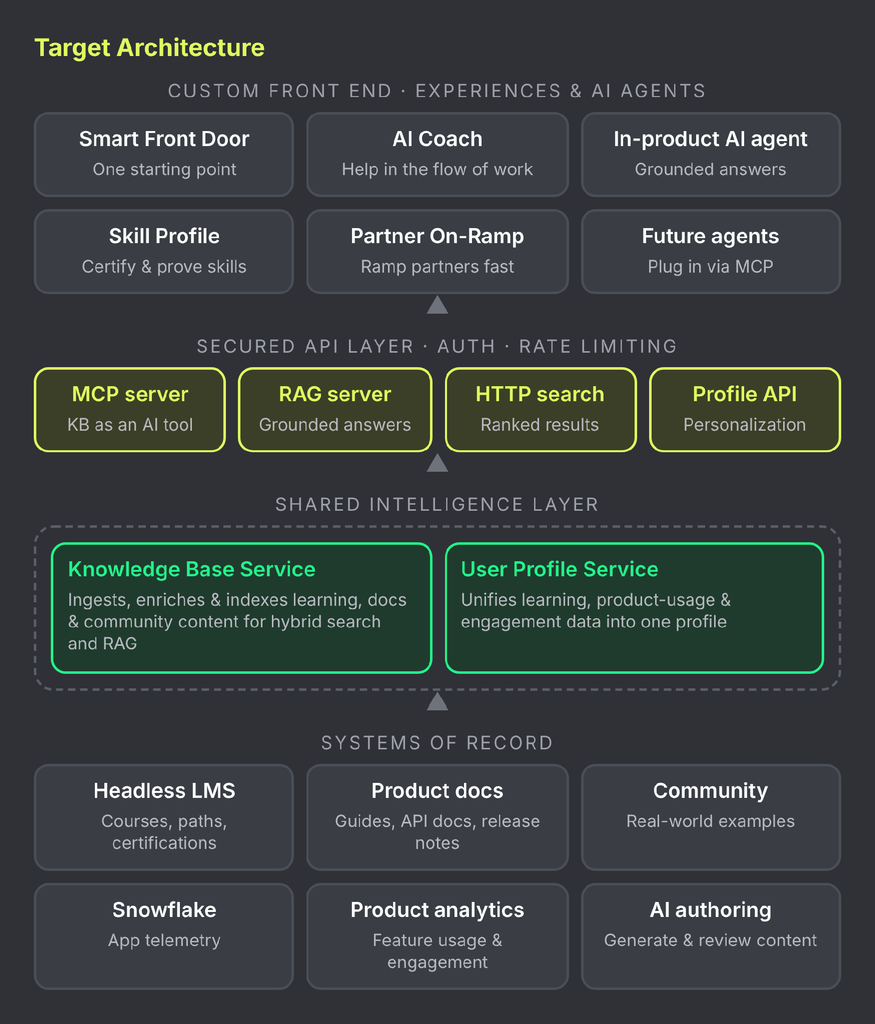
Because the knowledge layer sits outside any single platform, the company’s AI investment isn’t tied to its LMS vendor. Content can be added, platforms can change, and new agents can connect without rebuilding the foundation. As with all of Studion’s work, AI is part of the overall strategy, not added on afterward.
Architecture
Most LMS vendors keep their RAG APIs closed, their MCP servers (where they exist) reach only LMS content, and learner profile data stays inside the platform. Studion designed two services the company owns, each with a clear ingestion pipeline and a secured API.
Knowledge Base Service
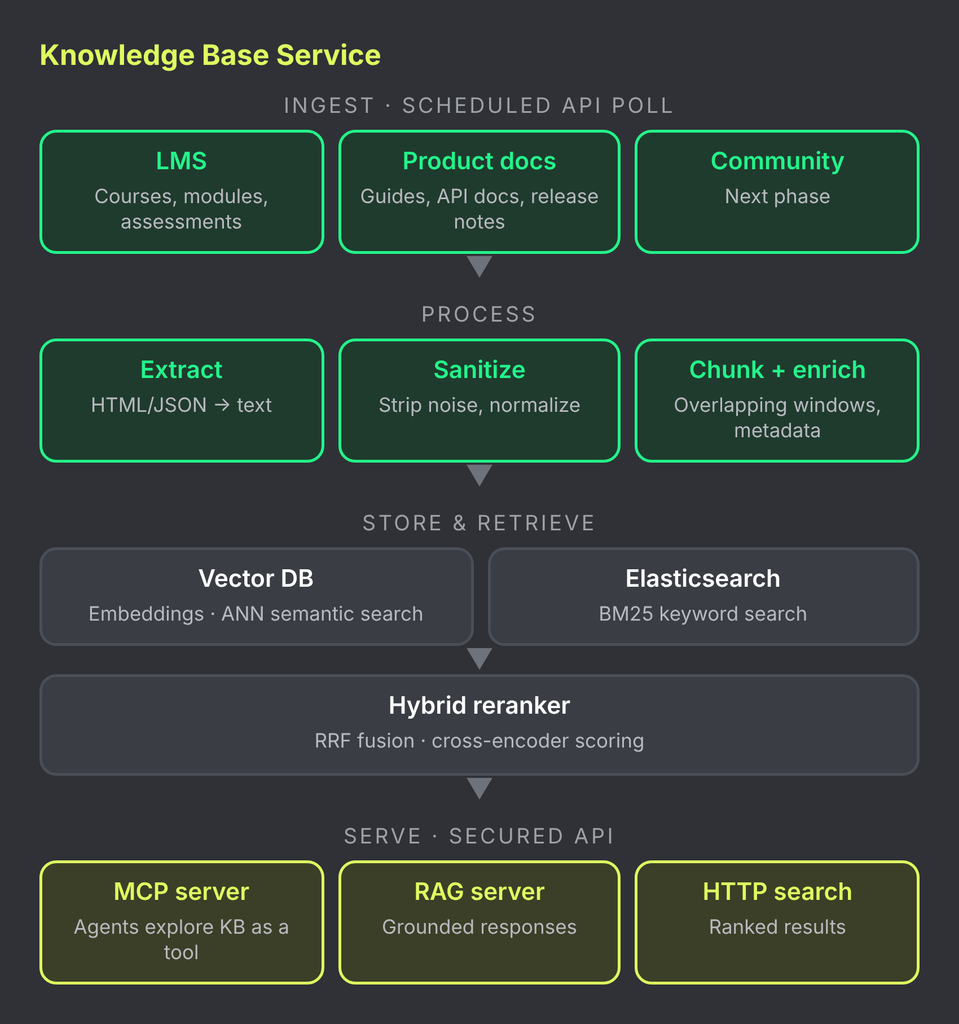
Polls the LMS and product documentation on a schedule (community content is next), extracts and cleans text from HTML and JSON, splits it into overlapping chunks, and enriches it with metadata. Content is indexed as embeddings in a vector database for semantic search and in Elasticsearch for BM25 keyword search. Results are merged with reciprocal rank fusion and reranked by a cross-encoder.
- MCP server: the knowledge base as a tool agents explore in natural language
- RAG server: grounded answers to user questions
- HTTP search server: a prompt or phrase in, ranked results out
User Profile Service
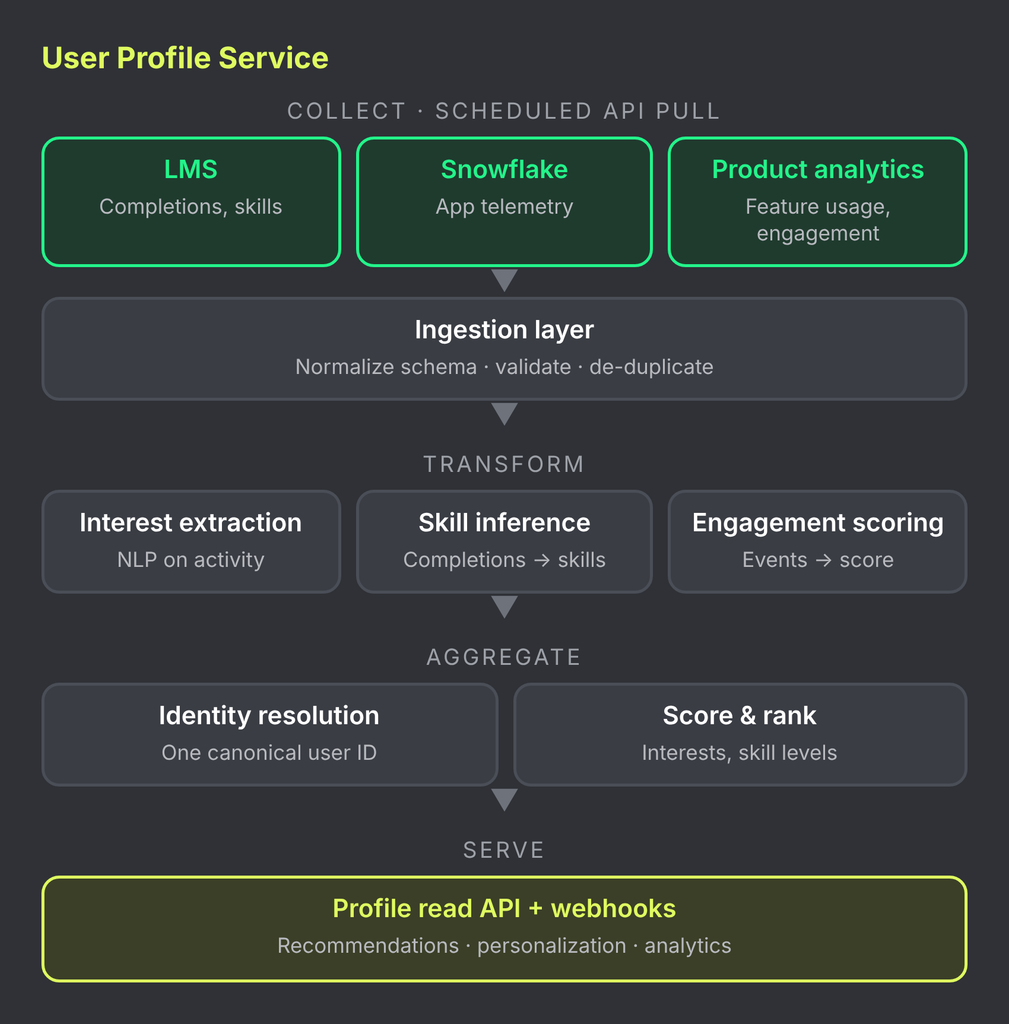
Pulls LMS completions and skills, Snowflake application telemetry, and product-analytics engagement data. An ingestion layer normalizes, validates, and de-duplicates records. Natural Language Processing (NLP) extracts interests from activity, completions map to skills, and events become engagement scores. Identity resolution matches records across systems to one canonical user ID.
The profile lives in a dedicated database and is exposed through a read API and event webhooks, so every experience can personalize recommendations, learning paths, and AI responses.
Impact
The architecture gives the company a clear, vendor-neutral path from fragmented content to connected intelligence. Expected outcomes include:
- One source of truth for every AI experience. Search, an AI coach, and an in-product agent all draw on the same indexed, curated content, so answers stay consistent and trustworthy.
- Faster delivery of new AI features. New agents connect to the knowledge base through MCP or the API instead of each building its own integration.
- Freedom from LMS lock-in. Knowledge and user profiles live outside any single vendor, so platforms can change without rebuilding the AI layer. The solution is extensible and supports easily adding data sources.
- Personalization at scale. A unified profile of skills, interests, and engagement drives relevant recommendations for customers, partners, and employees.
- Measurable business value. Learning engagement can be tied directly to product adoption, renewals, and expansion.
Now, the SaaS company can leverage years of expert knowledge as a trusted, reusable asset to enable future AI applications for every customer, partner, and employee.